

Connect approved systems without surrendering control.
NopsAI connects Git providers, work systems, AI profiles, MCP tools and runners through reviewed configuration, OIDC SSO, scoped authorization, self-hosted data boundaries and auditable runs.
MCP-ready systems, one governed control layer.
Every system here maps to an MCP server, a hosted MCP capability or a NopsAI MCP profile boundary before it enters policy, scope and audit.
Every integration declares how trust is established.
NopsAI does not flatten every system into an ambiguous connector. Event sources, business tools, AI providers and runners keep connection paths suited to their security and runtime role.
Repository and operational signals
Provider-specific verification stays at the edge while normalized events enter one trigger and authorization model.
GitHub App
GitHub
First-party Git automation
Webhooks, signed delivery validation, repository file access, check runs, reruns and stale-check cancellation.
Webhook source
GitLab
Managed Git events
Authenticated deliveries, repository allowlists, changed-file filters, rate limits and audit history.
Webhook source
Bitbucket and Gitea
Managed Git events
Provider-aware ingestion normalizes repository events while preserving source identity and delivery controls.
API or webhook
Generic services
Service signals
Authenticated APIs and HMAC or token-backed webhooks let internal systems initiate registered operations.
Tools reached through approved profiles
Business systems are exposed as bounded tools or service calls. The connection method, credential reference, allowed scope and runtime use stay explicit.
MCP profile or API
Jira and Monday.com
Planning and delivery
Read planning context or prepare approved updates without embedding credentials in pipelines.
Knowledge or MCP
Confluence and SharePoint
Knowledge systems
Bring policies, runbooks, specifications and architecture context into a run through reviewed profiles.
MCP profile or API
ServiceNow and Salesforce
Service operations
Coordinate incidents, changes, cases and approvals with caller-scoped tools and proposal-first mutation paths.
MCP or scoped context
Google Drive and documents
Content and outputs
Resolve approved documents and generated deliverables while keeping references attached to the run.
Execution providers with policy boundaries
Provider choice is configuration, not an escape hatch from authorization, scope isolation, runtime placement or evidence.
LLM profile
LLM providers
Goal-based tasks
Select Gemini, OpenAI, Anthropic, Groq, Mistral, OpenRouter, Ollama, LM Studio or Azure OpenAI through scoped profiles.
MCP profile
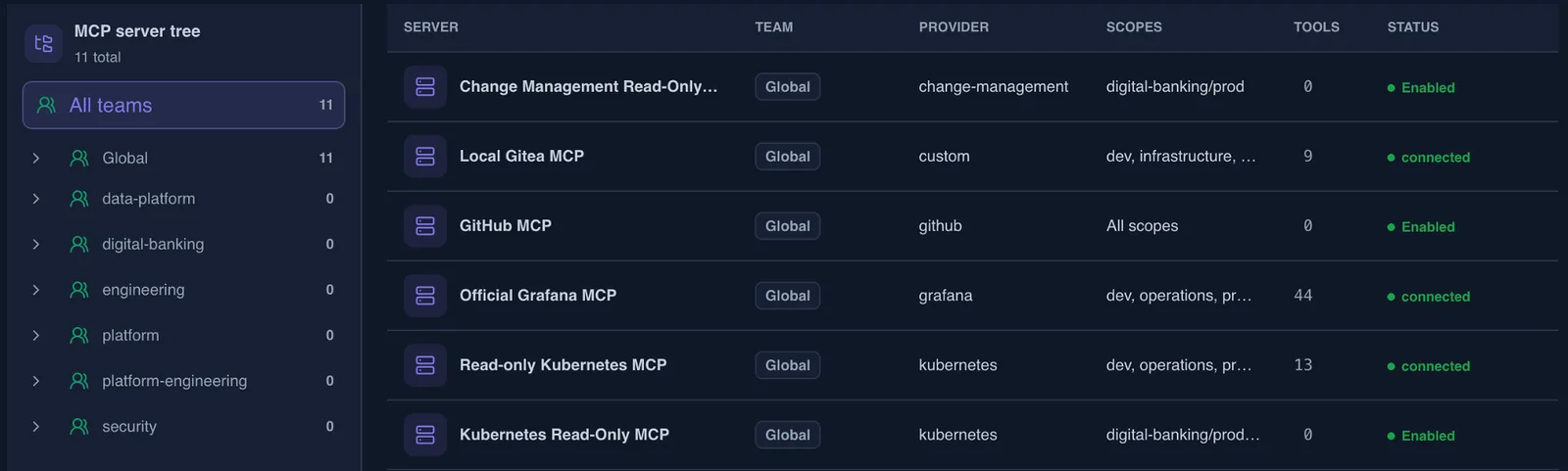
MCP servers
Approved tool access
Register servers and reusable profiles centrally, keep examples disabled by default, enable tools deliberately by scope.
Runner registration
Docker and Kubernetes
Isolated execution
Place per-run agents and step containers or pods on eligible runners selected by scope, affinity and capacity.
MCP, metrics and logs
MCP-backed operations
Monitoring evidence
Combine operational tools with health checks, dispatch state, runner state, service logs and authorization audit records.
How the systems teams ask about actually connect.
The connection method, credential handling and governed surface differ per system. These pages go through them one at a time.
GitHub
GitHub events start the run. Authorization decides what it may touch.
GitLab
GitLab events, normalized into one trigger and authorization model.
Kubernetes
Sensitive work runs where you decide, on your own cluster.
Jira
Planning context in, proposed updates out — through an approved profile.
ServiceNow
Incidents and changes coordinated under the caller's own authority.
MCP
Declaring an MCP server is not the same as making a tool available.
Ollama
A self-hosted platform is only self-hosted if the model is too.
Azure OpenAI
The model endpoint your procurement team already approved.
Keycloak
The identity that starts a run should be the one your directory owns.
Microsoft Entra ID
Your directory identity, carried all the way to the evidence.
Okta
Federated sign-in, and an audit trail that names a person.
Confluence
Your runbook is only a control if the run has to read it.
Notion
Where the specification lives should not decide whether it is enforced.
OpenRouter
One credential, many models, still one approval path.
LLM providers
Which model runs is a configuration decision, not a runtime one.
A tool is available only after four explicit decisions.
Server registration alone does not make a capability globally available. Configuration, scope, live authorization and evidence stay separate.
Define the server and profile
GitOps or system configuration names the MCP server, stable credential references, transport, tool policy and profile defaults.
Limit where it is available
Allowed scopes and team ownership constrain which pipelines, assistant conversations and operators can select the profile.
Filter tools through live AAA
NopsAI evaluates the caller, action, resource and runtime context before exposing or invoking permission-bound tools.
Keep tool use with the run
Selected profiles, tool calls, approval decisions, redacted logs and resulting outputs remain part of the execution record.
Know where every responsibility lives.
The self-hosted platform keeps durable control and evidence in your environment. External providers receive only the data and operations allowed by the profiles you configure.
Control plane
Authentication, AAA, configuration, run records, audit history and dispatcher coordination.
Execution plane
Per-run agents and isolated step containers or pods with scope, capacity, affinity and cancellation controls.
Configuration plane
Versioned operational definitions with live sync status, drift evidence and encrypted credential envelopes.
Provider plane
Explicit profiles determine credentials, scopes, endpoints and the external systems that receive selected data.
Bring your identity provider, systems, AI profiles and runtime boundaries.
We will map which systems connect as event sources, which become approved tools, and where each credential actually lives.