

Orchestrate deterministic and AI work in one governed DAG.
NopsAI treats AI-assisted work as part of a durable pipeline run. Dependencies, conditions, timeouts, approvals, context and outputs stay explicit from trigger to completion.
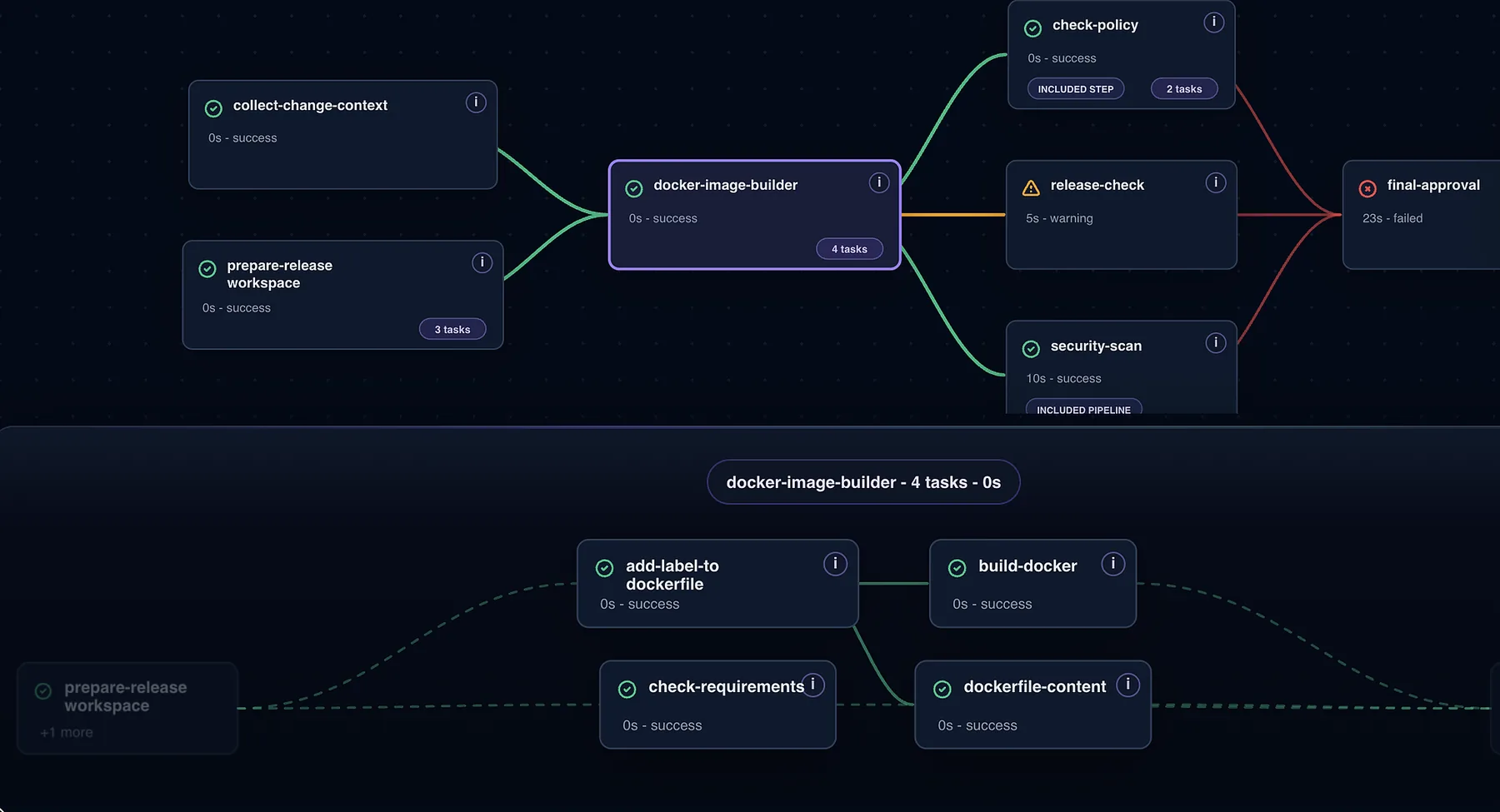
Workflow orchestration, end to end.
The flow stays explicit enough for operators to inspect, secure, automate and improve.
Normalize the signal
Git events, schedules, APIs, manual actions and external triggers become one consistent run request.
Resolve the definition
NopsAI loads pipeline YAML, reusable steps, knowledge context, scope, variables, secrets and access decisions.
Execute the graph
The agent advances dependency-aware tasks, pauses at approvals and delegates work to isolated step runtimes.
Attach the outcome
Status, logs, task history, approval decisions, AI usage and declared outputs stay owned by the run.
What teams can standardize.
These are current NopsAI platform primitives, not a future-state feature list.
Mixed execution steps
Use script tasks and LLM-backed goals in the same pipeline without hiding either execution path.
Reusable composition
Include reviewed shared steps or trigger child pipelines while preserving parent-child run history.
Human approval gates
Pause a run without holding a runner, then resume from persisted history and workspace state.
Run-owned deliverables
Generate Markdown, JSON, HTML, PDF, Excel or dashboard outputs after the pipeline completes.
Declared once, reviewed like code.
The example is declarative and Git-reviewable. Runtime behavior still passes through live AAA, credential, compatibility, execution and monitoring boundaries.
name: release-readiness
version: "1.0.0"
container_image: golang:1.24
agent_profile: release-manager
llm_profile: reasoning
knowledge_context:
  - kind: policy
    ref: platform/release
    required: true
steps:
  - name: validate
    include: step:platform/shared/release-checks
  - name: review
    depends_on: [validate]
    goal: Summarize release risk and propose a decision.
    mcp_profiles:
      - github-readonly
  - name: approve
    depends_on: [review]
    approval:
      type: production-release
      teams:
        - platform/prod
      allow_self_approval: false
      timeout: 24h
output:
  items:
    - name: Release brief
      type: markdown
      when: always
      prompt: |
        Summarize the release decision, the supporting
        evidence, and the approver.
Configuration stays inside the governance model.
Authorization before dispatch
Caller-scoped checks cover the pipeline and every protected resource referenced by the run.
Reviewable configuration
Pipeline and reusable-step definitions stay in Git with normal review and promotion controls.
Bounded AI access
Agent, LLM and MCP profiles are selected explicitly rather than constructed dynamically by a task.
Observable execution
Task state, logs, output generation, runner behavior and AI usage feed the same monitoring model.
Continue through the operating model.
02 · GitOps configuration
Manage pipelines, scopes, access, knowledge, profiles, triggers and runtime defaults as versioned configuration.
03 · Governance and AAA
Apply default-deny access decisions before configuration reads, tool use, secret resolution, approvals and dispatch.
04 · AI and MCP
Select controlled agent, LLM and MCP profiles per pipeline or step while preserving permission-bound tool discovery.
Bring a real workflow orchestration workflow.
We can map the configuration, authorization, runtime and evidence boundaries against your current platform model.