

The governed AI automation platform
you would otherwise build in-house.
Most teams assemble the same stack by hand: CI/CD jobs, scripts, an agent framework, secrets plumbing, policy checks, approvals, runners and correlated logs. NopsAI supplies that layer as a product, so AI-assisted engineering and operational workflows run inside your own infrastructure — under the guardrails, policies and runbooks you bind to each step, with caller-scoped access, the approval gates you place, and durable evidence of what every decision was bounded by.
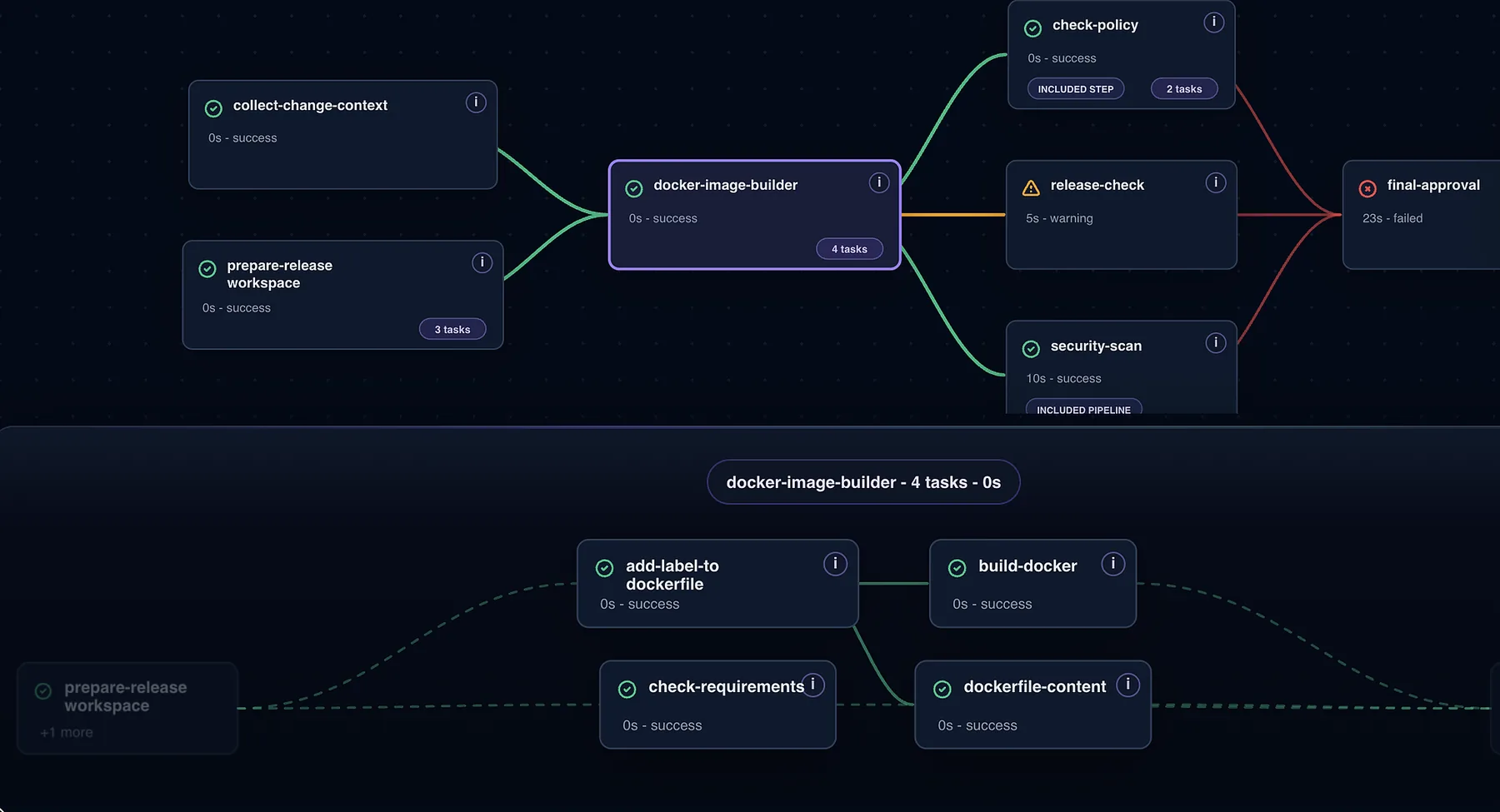
Every team building production AI ends up building the same platform.
The prototype works. Then security asks who authorized the agent, audit asks for the evidence, and another team starts the same integration from scratch. What follows is a custom integration project nobody planned for.
What you are maintaining today
A custom internal integration layer, owned by a small number of engineers.
- Expensive to build, harder to keep consistent
- Coupled to one use case, hard to reuse across teams
- Evidence scattered across five systems
- Risky to extend with production credentials
What NopsAI replaces
One governed execution layer. Your existing tools stay where they are.
NopsAI integrates with your CI/CD, secrets manager and observability stack. It replaces the orchestration and governance layer you would otherwise write yourself.
One workflow. Deterministic steps, AI reasoning, approvals — and the evidence that follows.
A pipeline collects context, runs deterministic checks, lets a model reason only within the tools, credentials and written policies you gave it, pauses at the approval gates you placed, then executes and records everything as one run.
Not an agent framework
Agents and models are replaceable components inside the platform, not the platform itself.
Not a shared SaaS
Your workflows, credentials, models and run data stay inside infrastructure you control.
Not a CI/CD replacement
It governs AI-assisted work across the systems you already run — it does not ask you to leave them.
Every boundary an AI workflow needs, defined once.
Model access, tool access, credentials, context and permissions are configured at the platform, pipeline, step or task level — and inherited everywhere below.
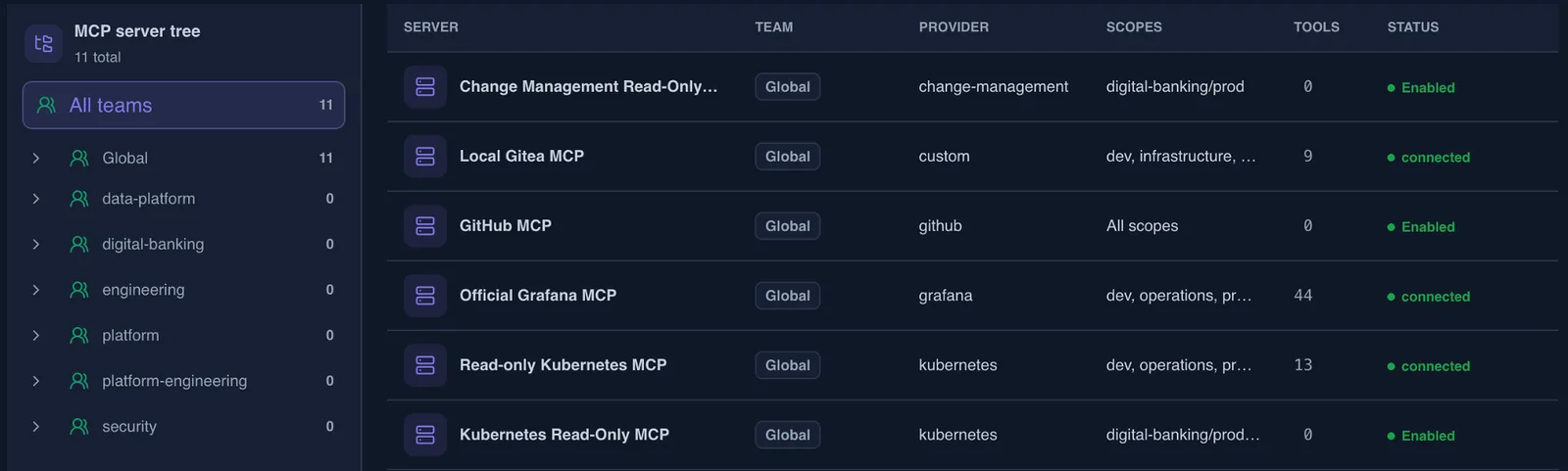
A workflow can only reach MCP servers its scope allows. Tool counts, providers and connection health are visible per team, so nobody has to guess what an agent could touch.
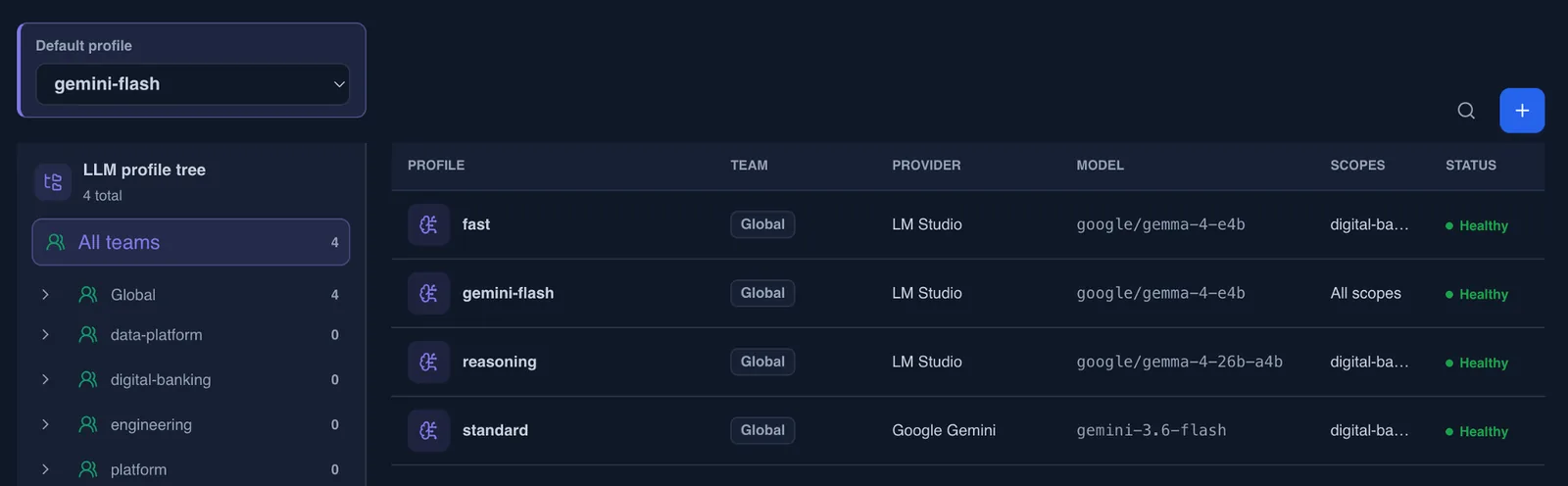
Use a cheap local model for summarising and a reasoning model only where it earns its cost. Profiles are scoped, health-checked and swappable without touching pipeline logic.
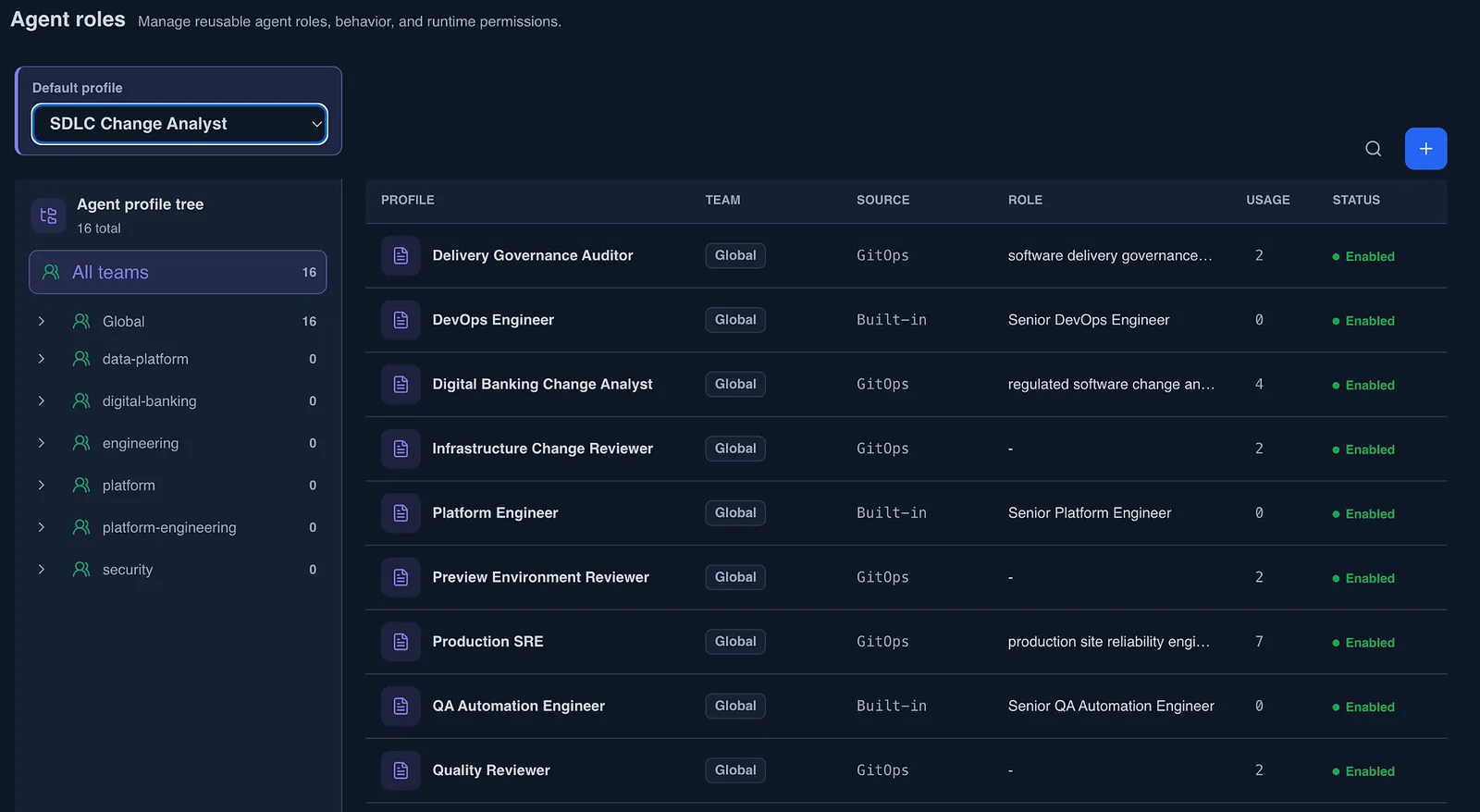
Agent behavior is a reusable, versioned object — not a prompt buried in a repo. A Production SRE role carries its own role description, instructions and usage count across every pipeline that references it. Model, tools and permissions stay separate profiles.
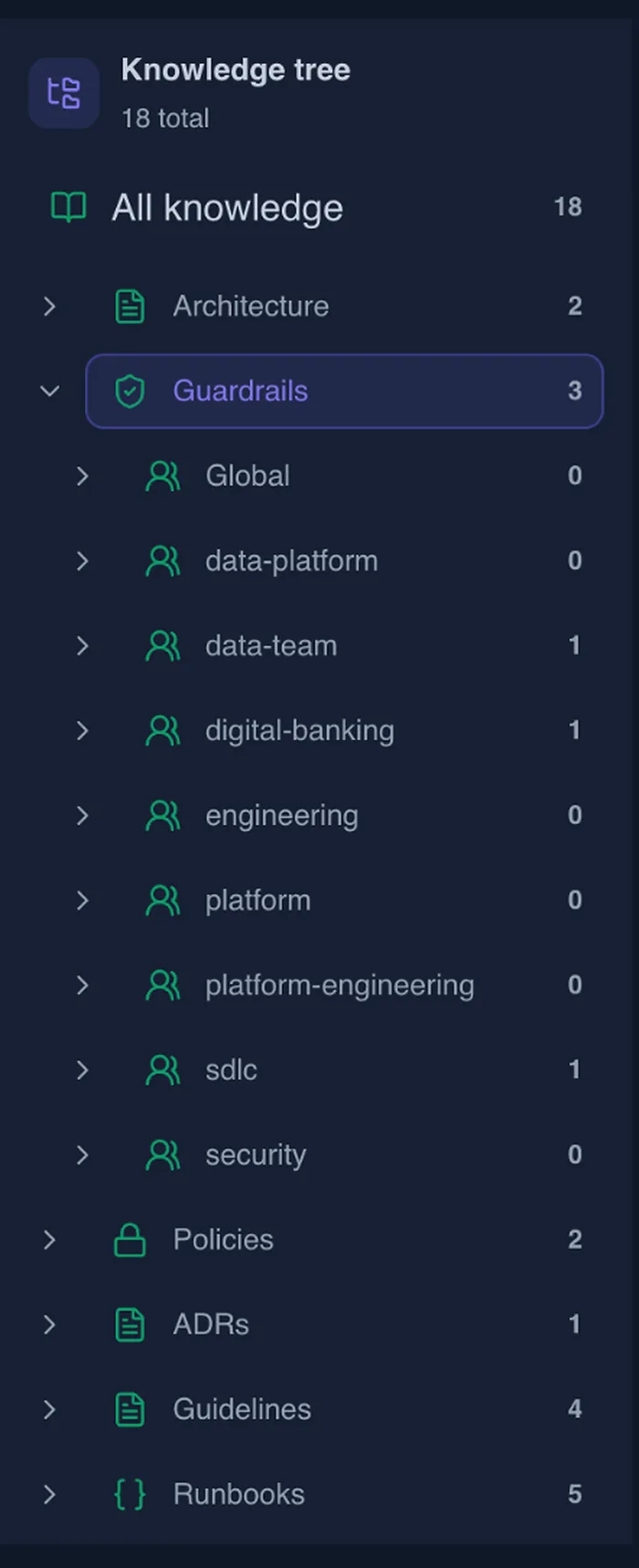
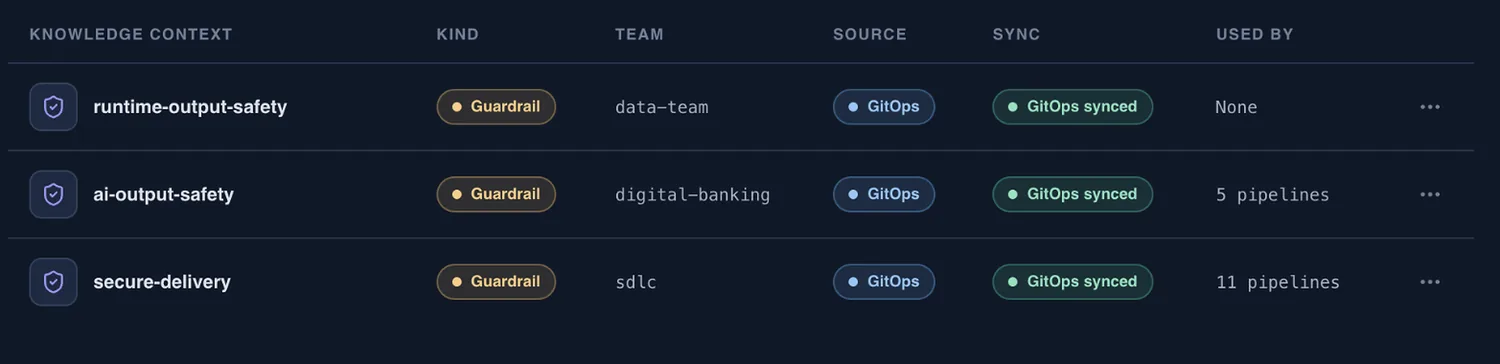
Guardrails, policies, ADRs, guidelines, runbooks and architecture notes are documents your team writes and reviews. You decide which of them constrains which pipeline, step or task — and guardrails and policies are checked against the goal, the generated command, file writes and MCP arguments before anything runs.
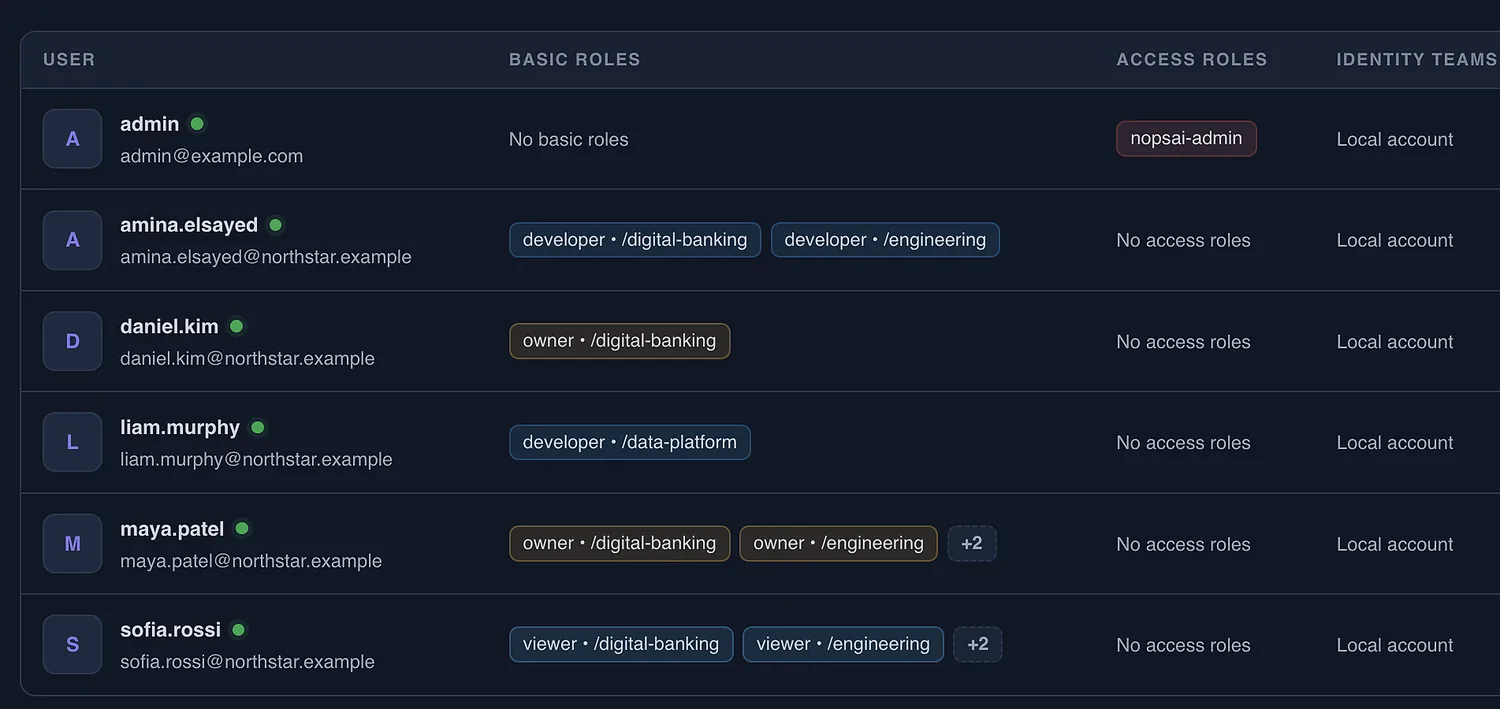
Roles are bound to team paths, not to a flat permission list. Authorization is resolved for the caller before a run is dispatched — and it fails closed.
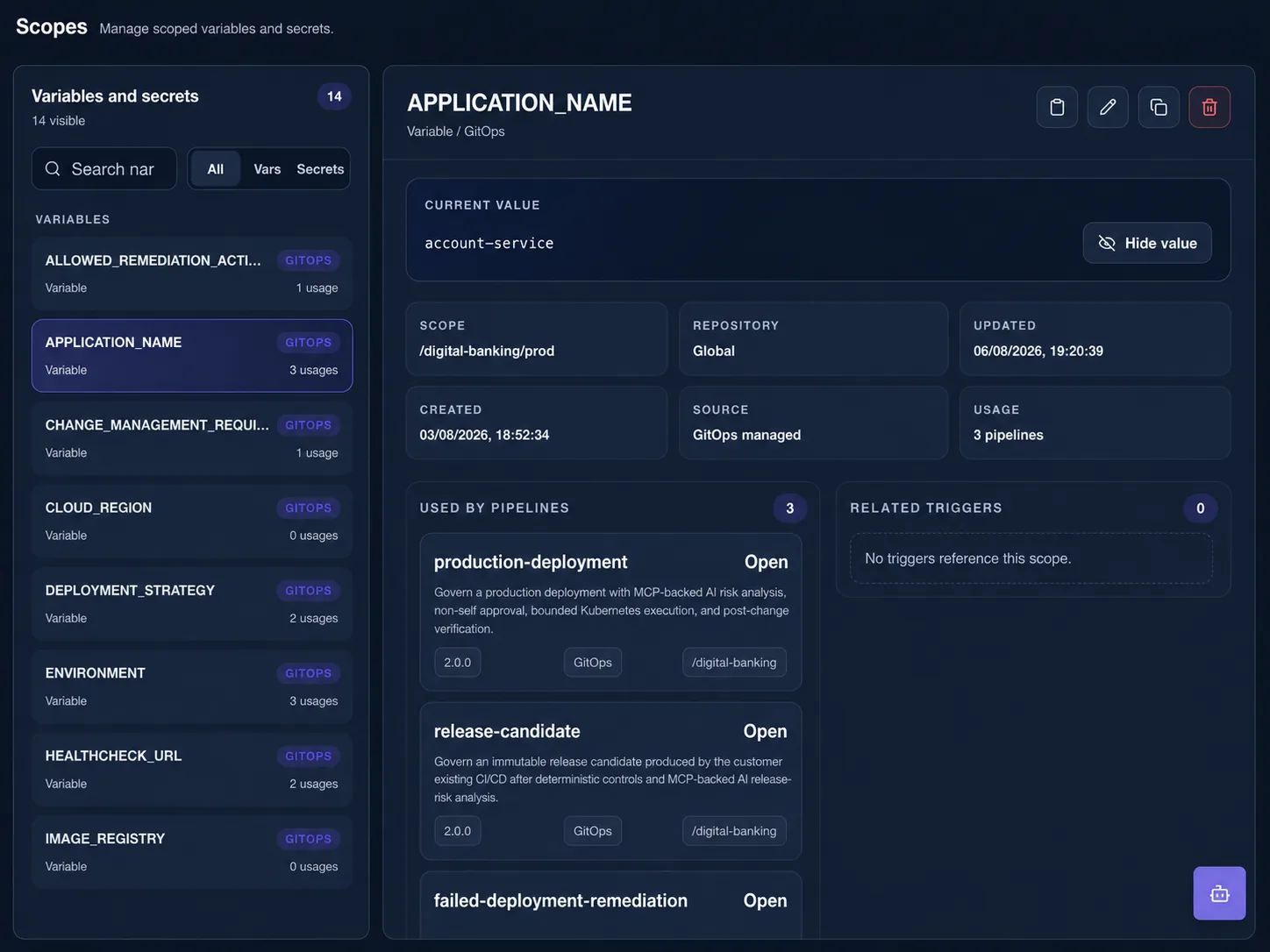
Every variable and secret shows its scope path, its GitOps source and exactly which pipelines consume it. Changing a value is a decision with a known blast radius.
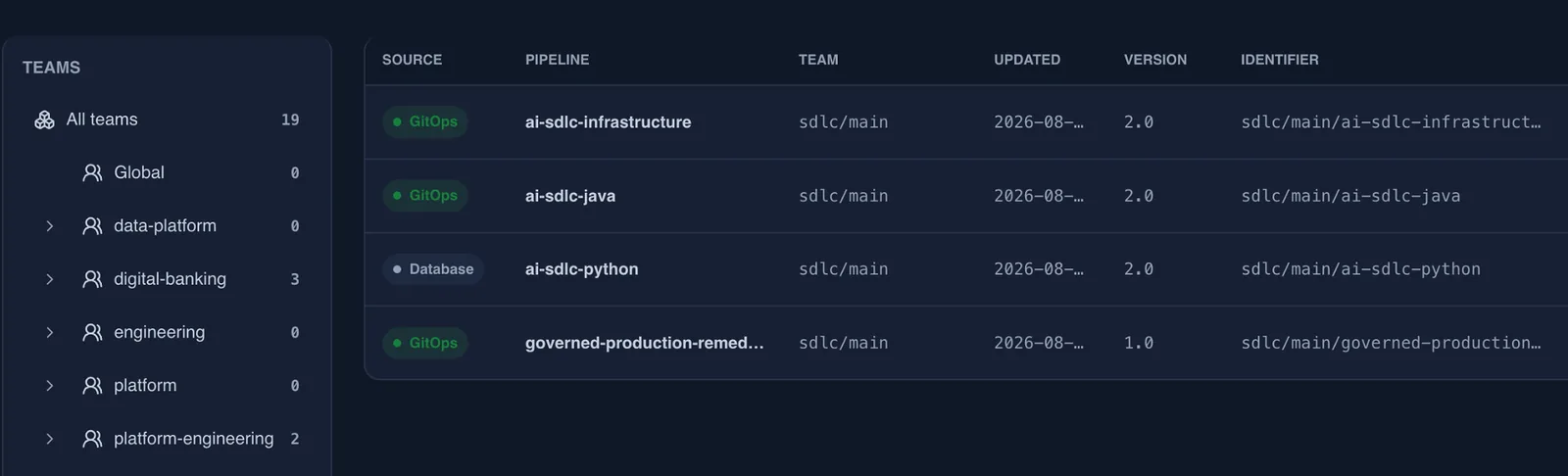
Pipelines, steps, roles, knowledge and scopes are declared in Git and synced into the platform — reviewed like code, versioned like code, reverted like code.
You decide which policy constrains which step.
Guardrails, policies, ADRs, guidelines, runbooks and architecture notes are documents your team writes and reviews in Git. You attach each one where it applies — a whole pipeline, a single step, one task — and the model works inside the set you gave it. A guardrail is not advice the model may weigh up: it is checked against the goal, the generated command, the file write and the MCP arguments, and a conflict fails the task instead of executing.
- Eight kinds — architecture, guardrail, policy, ADR, guideline, runbook, reference, example
- Bound at pipeline, step or task level, with narrower bindings adding to broader ones
- Team defaults a pipeline can add to but cannot weaken or remove
- The exact documents that bounded a decision stay on the run record
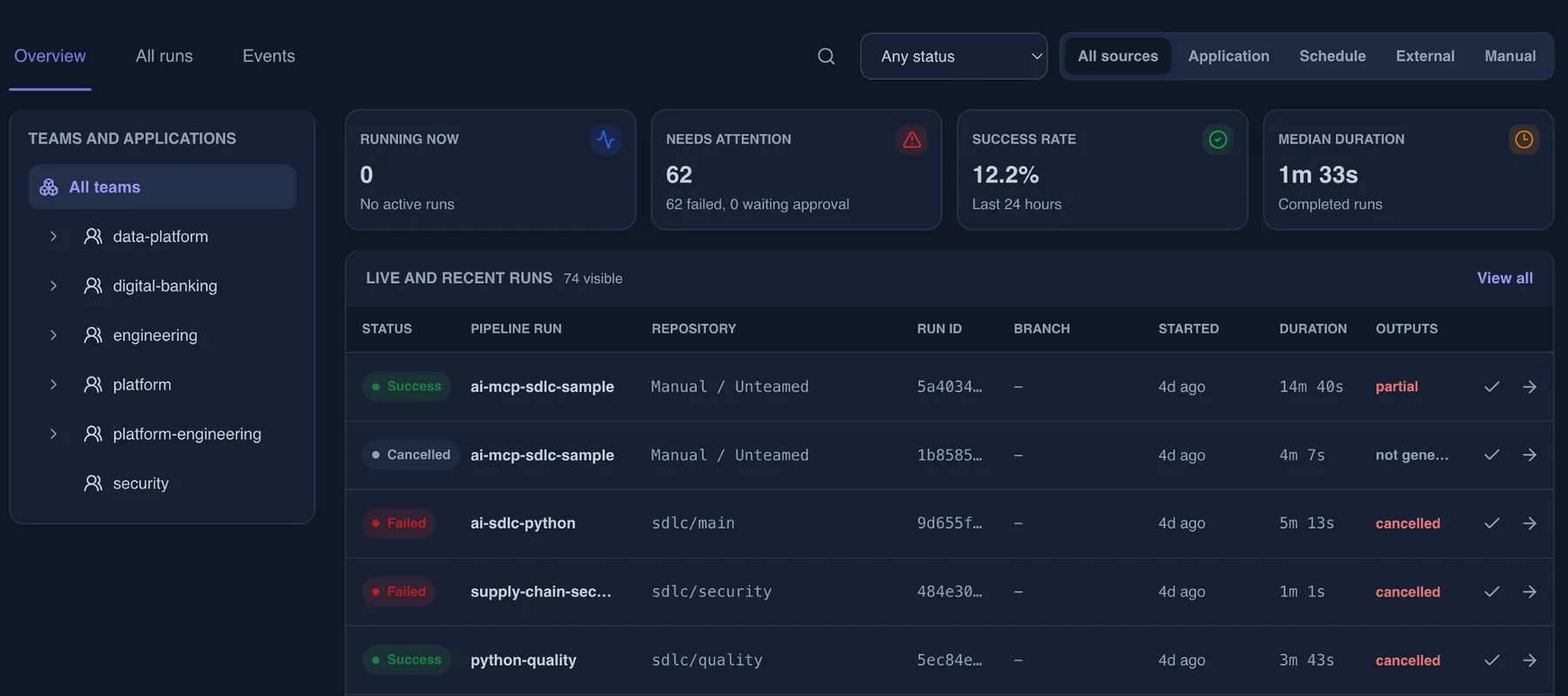
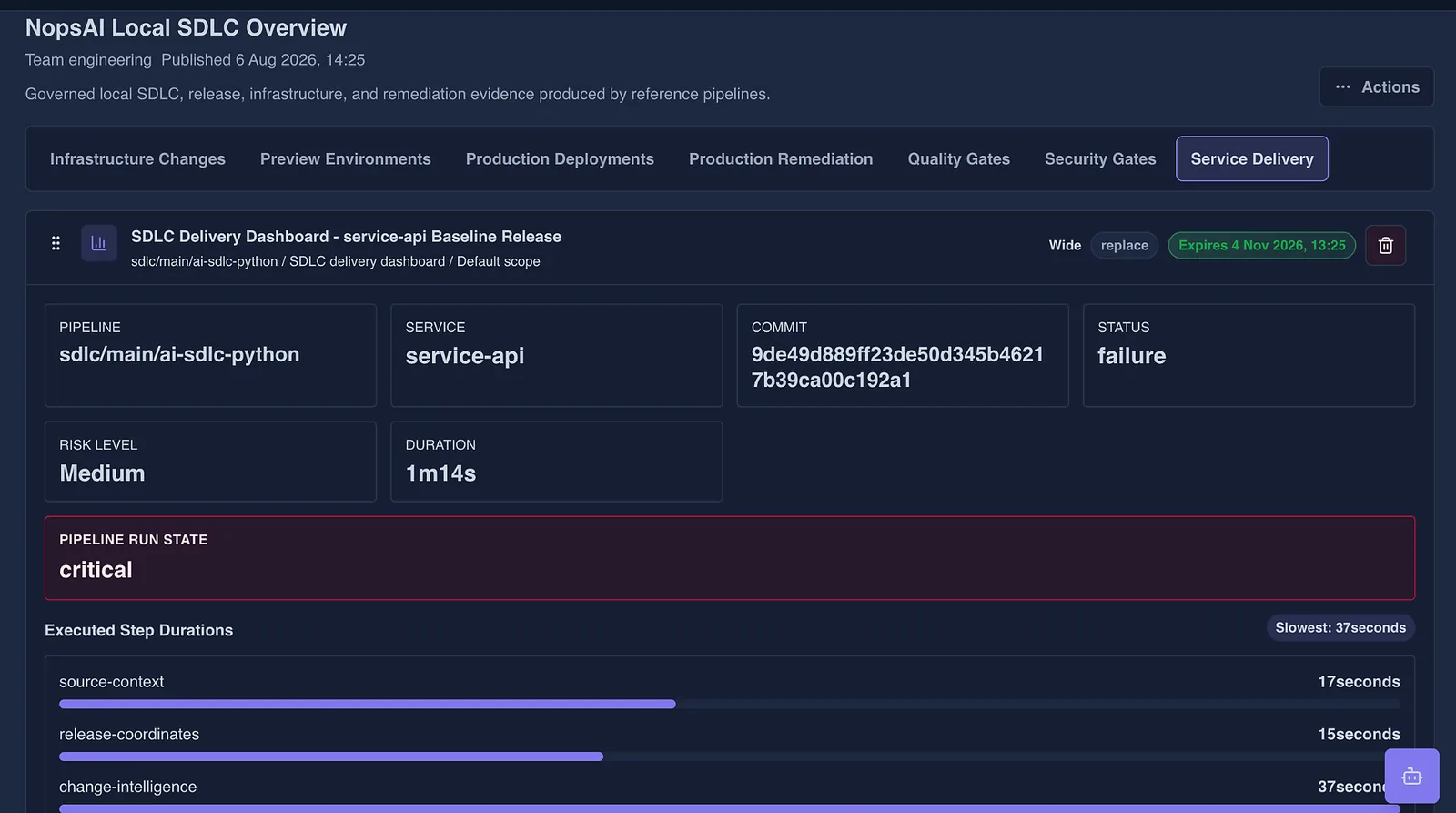
One run record. Not five systems and a best guess.
Inputs, outputs, logs, tool calls, AI activity, approvals, durations and failures are attached to the run that produced them. When an audit, a security review or a postmortem asks what happened in production, the answer is one run record rather than a reconstruction across five systems.
A failed deployment, handled without unrestricted production access.
The same shape works for infrastructure changes, alert investigation, change-risk assessment and controlled maintenance procedures.
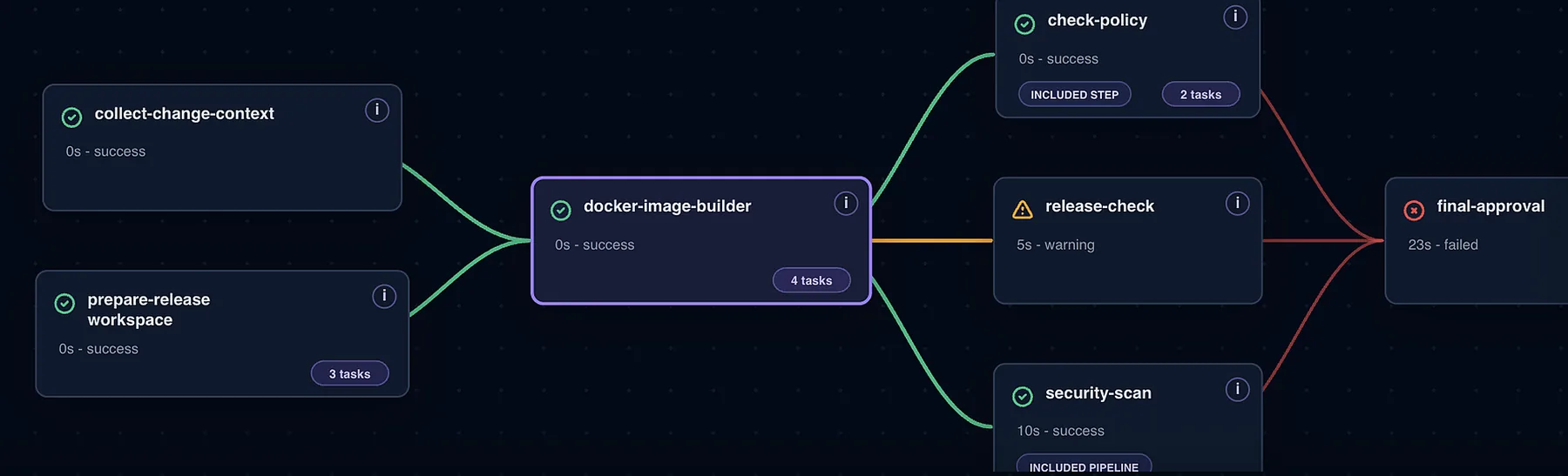
Trigger
A Git event, schedule, API call, incident or a person clicking run. Every entry point resolves to the same governed path.
Collect context
Logs, configuration, runbooks, policies and environment state — gathered by deterministic steps before any model is involved.
Verify deterministically
Scripted checks confirm the current state. No model call where a deterministic check is sufficient.
Reason within boundaries
The model diagnoses and proposes an action using only the approved tools, credentials and systems its profile allows.
Pause where you put a gate
You decide which step needs a named approver. The run holds its state at that gate, releases the runner, and resumes exactly where it paused.
Execute, verify, record
Approved actions run in a bounded Docker or Kubernetes runtime, the result is validated, and the run is preserved as evidence.
Familiar work, shown as governed runs.
Every use case starts with the tool-hopping teams already recognize, then shows the governed pipeline that gathers context, runs approved steps, pauses at the gates its author placed, and leaves evidence behind.
A customer-reported bug needs to ship as a hotfix
The fix is small, but no single durable trail connects the complaint, the code change, the test result and the emergency approval.
Sprint planning for the next two weeks
Planning starts with manual research instead of decisions. Blockers surface late and half-ready stories enter the sprint.
Production incident at 2 a.m.
At 2 a.m. the hard part is finding what changed and deciding whether rollback is safe — fast, without losing the evidence trail.
QA is blocked on unclear requirements
QA loses time reconstructing intent. Testing can start from the wrong assumption and clarification cycles cost a day or more.
Preparing a release
Scope mismatch, unmerged PRs, failed gates and an outdated runbook can all cause a late surprise.
A CI/CD pipeline suddenly starts failing
Most failures are a diagnosis problem before they are an engineering problem, and diagnosis eats the first thirty minutes.
Each of these solves part of it. None of them solves the layer between.
Individual capabilities exist elsewhere. The difference is having them integrated in one self-hosted platform built for governed engineering work.
| Capability | CI/CDActions, GitLab CI, Jenkins | Workflow automationn8n, Zapier, Make | Agent frameworksLangGraph, LangChain, CrewAI | NopsAI |
|---|---|---|---|---|
| GitOps-owned platform configurationOperational definitions need review, promotion, rollback and drift evidence across environments. | Partial Strong for pipeline files | Partial Varies by product | External Supplied by the application | Core Built into the platform model |
| Caller-scoped AAA before dispatchStarting a run and using each referenced runtime resource are separate authorization decisions. | Partial Repository and environment controls | Partial Workspace and connection controls | External Application responsibility | Core Product and runtime checks |
| Scripts and goal-based steps in one DAGTeams need deterministic checks and LLM-assisted reasoning inside the same dependency graph. | Partial Scripts are the primary model | Partial Connector actions are the primary model | Partial Agent reasoning is the primary model | Core One pipeline definition |
| Approved LLM and MCP profilesProvider, credential, scope, model, tool and timeout choices should be centrally governable. | External Custom integration required | Partial Connection-level configuration | Partial Framework configuration | Core System registry and scopes |
| Guardrails bound to a stepThe rule that constrains a decision has to be chosen per step by the pipeline author, authorized for the caller, and enforced against the action the model actually proposes. | External No context primitive; wired per job | External No governed context model | Partial Prompt and retrieval, not bound policy | Core Per-step documents, authorized and enforced |
| Docker and Kubernetes runner placementSensitive work needs eligible execution locations selected by scope, affinity, capacity and state. | Partial Runner model varies by system | External Usually product-hosted | External Application infrastructure | Core Dispatcher-managed runners |
| Scoped secret and variable resolutionA run needs its values assembled before execution without embedding a secret in the definition that gets reviewed in Git. | Partial Secrets and artifacts | Partial Workspace-bound connections | External Application responsibility | Core Scopes and credential references |
| Human approval inside the run graphA run must pause for a named approver and resume from persisted state without holding a runner. | Partial Environment approvals | Partial Wait steps | External Custom approval workflow | Core Approval step with durable resume |
| Durable run evidenceOperators need the trigger, policy decisions, context, logs, outputs and final state in one record. | Partial Build and deployment history | Partial Execution history | External Observability must be assembled | Core Run-owned evidence model |
| Proposal-first AI changesGenerated pipeline, trigger and schedule changes should return to explicit review rather than mutate production silently. | External Custom review workflow | External Custom approval workflow | External Application responsibility | Core Read and proposal-only assistant tools |
Category comparisons describe common design centers, not every implementation or product edition. “External” means the capability is achievable, but you build and maintain it yourself.
Self-hosted, because production access stays inside your boundary.
Runs in your infrastructure
Cloud, private or on-premises. Workflow data, credentials and run evidence never leave your boundary.
Docker and Kubernetes runners
Each step executes in an isolated runtime with only the resources its scope permits.
Your models, hosted or local
Commercial APIs, self-hosted models, or both — selected per step and replaceable without rewriting workflows.
Platform, DevOps and engineering teams putting AI near production.
You are likely a fit if more than a couple of these sound familiar:
- Leadership wants an AI initiative in production, and security will not approve unrestricted access.
- Several teams are independently building scripts, agents and CI/CD automations with different controls.
- An audit or customer requirement created real demand for approvals and execution evidence.
- An incident exposed how much depends on manual runbooks and two specific engineers.
- You need self-hosting, data residency or customer-controlled execution.
- Agent experiments produce cost and behavior nobody can explain afterwards.
Bring one workflow. We will map its controls, runtime, and evidence with you.
The fastest way to evaluate NopsAI is a single real workflow you already run manually and cannot safely hand to an unrestricted agent.