

Authorize the caller, the resource, and the runtime action.
NopsAI combines product roles with low-level authentication, authorization and audit controls. Runtime checks stay caller-scoped across users, repositories, services and scheduled work.
Governance and AAA, end to end.
The flow stays explicit enough for operators to inspect, secure, automate and improve.
Authenticate the subject
Resolve a local session, OIDC identity, personal token, service-account token, repository identity or internal service identity.
Expand product intent
Product roles and folder grants map to low-level AAA actions and inherited resource paths.
Evaluate each boundary
NopsAI checks route access and runtime use of pipelines, scopes, steps, secrets, variables, knowledge, runners and tools.
Record the decision
Denied and sensitive allowed operations are written to authorization and product audit records.
What teams can standardize.
These are current NopsAI platform primitives, not a future-state feature list.
Enterprise identity
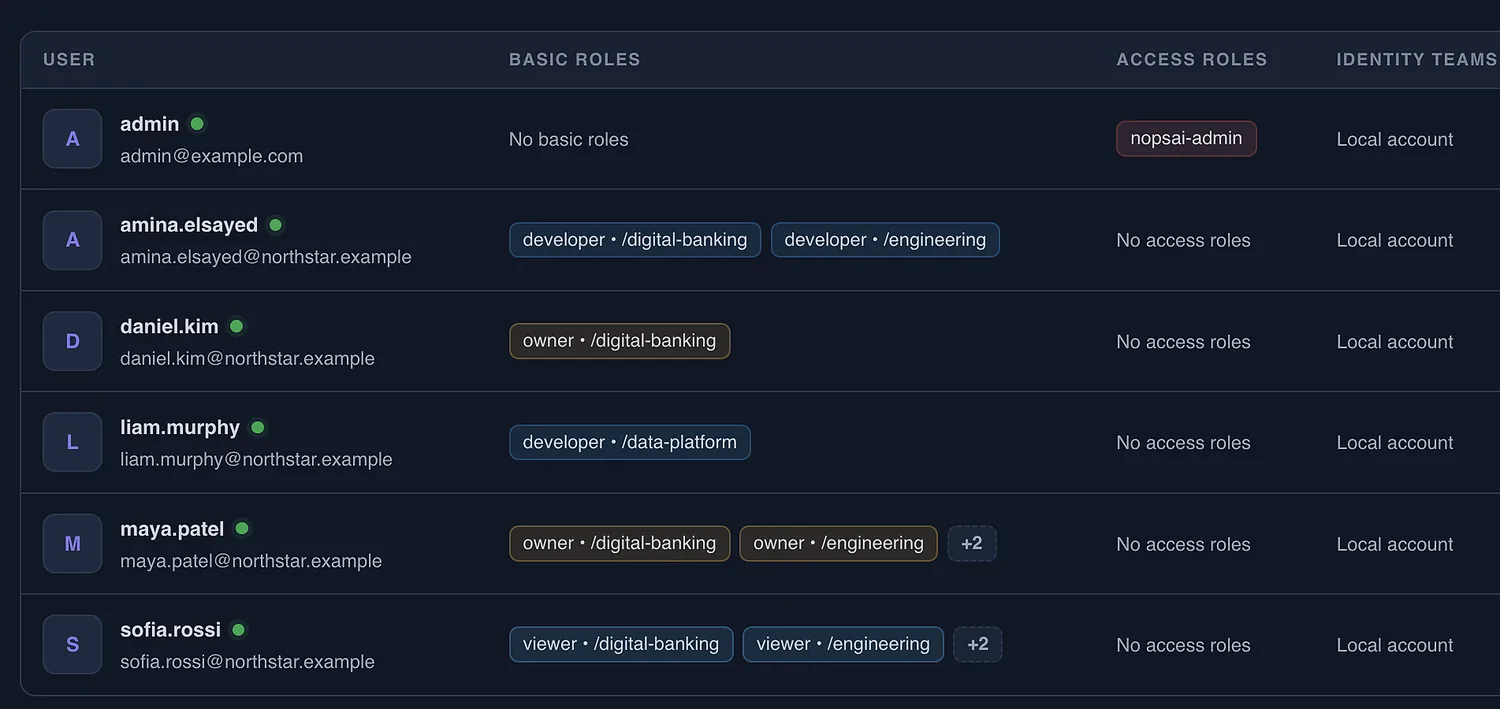
Local authentication, JWT sessions, personal tokens, service accounts and OIDC-backed identity providers.
Inherited access grants
Apply viewer, developer, owner or admin intent at a team path and inherit it through the hierarchy.
Resource-use authorization
Check protected references at run creation instead of relying only on route-level access.
Approval separation
Assign approval teams and optionally prevent users from approving their own gated work.
Declared once, reviewed like code.
The example is declarative and Git-reviewable. Runtime behavior still passes through live AAA, credential, compatibility, execution and monitoring boundaries.
users:
  - sub: alice
    email: [email protected]
    advanced_roles: [release-manager]

service_accounts:
  - sub: release-scheduler
    email: [email protected]

advanced_roles:
  - name: release-manager
    policies:
      - resource: pipeline:platform/*
        action: pipeline.execute

basic_roles:
  - user: alice
    role: owner
    resource: team:platform
  - service_account: release-scheduler
    role: developer
    resource: team:platform/prod
Configuration stays inside the governance model.
Policy service with fallback
The standalone AAA decision service is primary, with a compatible in-process evaluator for temporary outages.
Scope isolation
Scoped variables and secrets resolve only from the requested scope chain; scoped runs do not fall back to unscoped values.
Secret masking
Resolved secrets are protected in storage and masked from agent logs and execution history.
Service authentication
Dispatcher, runner, agent and internal callbacks use explicit service identity rather than user impersonation.
Continue through the operating model.
04 · AI and MCP
Select controlled agent, LLM and MCP profiles per pipeline or step while preserving permission-bound tool discovery.
05 · Knowledge and context
Write the guardrails, policies, ADRs, runbooks and architecture notes that bound AI work, and decide which of them constrains which step.
06 · Runtime and execution
Dispatch per-run agents to Docker or Kubernetes runners using scope, capacity, affinity, routing and runtime pools.
Bring a real governance and aaa workflow.
We can map the configuration, authorization, runtime and evidence boundaries against your current platform model.